
Introduction
If you’ve ever read a financial report, heard a business podcast, or watched a CEO on TV, you’ve probably heard the term ebita meaning. It sounds a bit serious and complicated, doesn’t it? But don’t worry! We’re going to make it super simple to understand.
The EBITA meaning helps explain how much money a business really makes before it has to count certain costs. It’s a common tool used by business owners, investors, and accountants to measure how a company is doing without all the extra financial “noise” like taxes and interest.
In this article, we’ll explain what EBITA stands for, why it matters, and how to use it. We’ll show you how companies calculate EBITA, how you can read it in financial reports, and how it compares to other business terms. Even if you’re new to business or finance, you’ll understand it by the end—and maybe even teach someone else!
Let’s dive into the world of EBITA, one easy step at a time.
EBITA Meaning: A Simple Definition
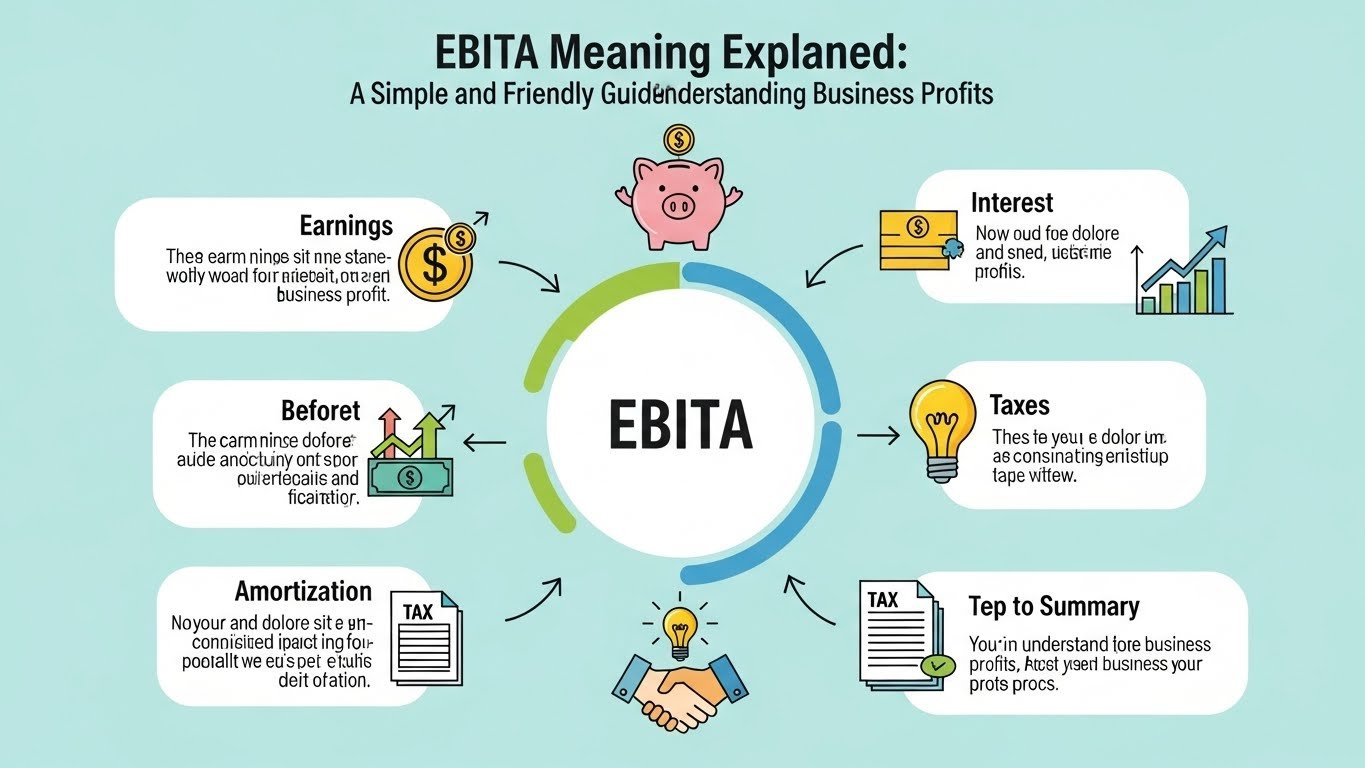
Let’s start with basics. EBITA stands for:
Earnings Before Interest, Taxes, and Amortization
Sounds complicated, right? Let’s break it into simple terms.
- Earnings are profits or the money a company makes.
- Before Interest means we don’t count the money the company pays on borrowed funds.
- Before Taxes means government taxes on income are not included yet.
- Before Amortization means we leave out the cost of things like patents or software that lose value over time.
So, EBITA meaning tells us: How much money is this company making before it has to pay for debt, taxes, or the slow cost of non-physical assets going down in value?
It focuses only on how well the core business is running.
Why Do People Use EBITA?
Great question! The EBITA meaning helps people look at a company’s real performance without letting other things confuse the numbers.
For example, if two companies earn the same amount every month, but one has huge tax bills and the other has big loans, their net income (final profit) will look very different. But their EBITA might be the same—meaning their operations are performing equally well.
Investors, bankers, and analysts like EBITA because it shows the health of the actual business, not how clever someone is at reducing taxes or managing loans. It makes comparisons fairer and more consistent.
Remember: EBITA tells you what’s happening inside the business itself—not what’s happening with laws, taxes, or accounting tricks.
EBITA Formula: How Is It Calculated?
The EBITA meaning makes more sense when we see how it’s calculated.
Here’s a simple version of the basic formula:
EBITA = Net Income + Interest + Taxes + Amortization
Let’s break it down:
- Net Income is a company’s profit after everything has been subtracted.
- Then we add back expenses that we didn’t want to include in EBITA.
- Interest: Money paid on loans.
- Taxes: Government payments on profits.
- Amortization: The cost of intangible items (like patents) losing value over time.
Let’s say a company had a net income of $100,000 but also paid:
- $20,000 in interest
- $30,000 in taxes
- $10,000 in amortization
Using the formula:
EBITA = 100,000 + 20,000 + 30,000 + 10,000 = 160,000
That means the company’s EBITA is $160,000—its operating profit before all those other costs.
What’s the Difference Between EBITA, EBITDA, and EBIT?
This is where finance can get confusing, but don’t worry—we’ll make it clear.
All three terms are cousins! They’re similar, but each includes or excludes different things.
- EBIT = Earnings Before Interest and Taxes
- EBITA = Earnings Before Interest, Taxes, and Amortization
- EBITDA = Earnings Before Interest, Taxes, Depreciation, and Amortization
What’s the difference?
- EBIT includes the cost of assets (like equipment) that lose value over time (this is called depreciation).
- EBITA removes amortization only.
- EBITDA removes BOTH depreciation and amortization.
You can think of them like this:
- EBIT = Pure profit before taxes and interest
- EBITA = EBIT, but with less impact from hard-to-see costs like patents
- EBITDA = EBITA + ignoring even physical wear-and-tear
People pick the one that’s most useful for their needs, but EBITA finds a sweet middle spot.
When Should You Use EBITA Instead of Other Metrics?
You should use EBITA when you want to measure how well a company performs on its daily business—without other financial distractions.
It’s VERY helpful in several situations:
- When comparing companies in different countries with different tax rates
- When looking at companies with different loan obligations
- When a business has lots of intangible assets (like trademarks, brand value, or non-physical property)
EBITA gives you the chance to step back and see the truth: “Is the basic business model working well?”
If you’re a small business owner, investor, or student learning finance, EBITA gives real clarity around performance.
Real-Life Example of EBITA in Action

Imagine two businesses: Company A and Company B. Both sell children’s books online.
Company A had:
- Net Income = $60,000
- Taxes = $10,000
- Interest = $5,000
- Amortization = $5,000
EBITA = 60,000 + 10,000 + 5,000 + 5,000 = $80,000
Company B had:
- Net Income = $80,000
- But no taxes, little amortization, and no loans (so EBITA = $82,000)
On paper, Company A didn’t “perform” as well based on net income. But their EBITA is very close to Company B’s. That means both businesses are doing great at selling books—it’s just that Company A had higher taxes and some loans to pay.
Now you can see how EBITA gives a fuller, fair view.
What Are the Limitations of EBITA?
While EBITA is helpful, it’s not perfect.
Here are a few things to watch out for:
- It ignores real costs – Like taxes and interest, which actually do matter in the long run.
- Companies may use it to hide bad performance – Someone could focus too much on EBITA to make results look better than they really are.
- It’s not a legal number – EBITA is not part of Generally Accepted Accounting Principles (GAAP), so it’s often used in addition to official earnings.
This means you should always look at EBITA alongside other numbers, like net income and cash flow. Use it to learn—not to judge alone.
How Businesses Use EBITA to Make Smart Decisions
EBITA doesn’t just help outsiders. Even company owners and staff use it!
Here’s how:
- Managers use EBITA to track performance over time, especially when launching new products.
- Finance teams compare EBITA month-by-month to see if the brand is improving or falling behind.
- Leaders use it when planning for sales, investments, or partnerships because it reveals core strength.
Since EBITA removes outside factors, companies feel it gives an honest view of whether their operations are truly working or need improvement.
How Investors Use the EBITA Meaning for Valuation
Investors love EBITA because it helps them decide one BIG question:
“Is this company worth investing in?”
They might use EBITA to:
- Compare one company to another, even across different industries
- See how efficiently a company runs, regardless of taxes or debts
- Value a business for potential purchase
Often, investors will even calculate something called the EBITA margin, which is:
EBITA ÷ Revenue × 100 = EBITA Margin (in %)
This percentage shows how much of a company’s revenue is turning into core profit. The higher the number, the better!
It’s a powerful tool when buying or analyzing companies.
Comparing EBITA Across Industries: Is It Always Fair?
Not always. Some industries are more impacted by amortization than others.
- Tech companies often have lots of intangible assets (like software and patents)—so EBITA is helpful.
- Manufacturing companies have more depreciation (machines wearing out), so EBITDA or EBIT might be better.
So, when using EBITA meaning across industries, make sure you also understand each business type. What works in one field might not tell the full truth in another.
A helpful tip: Always check why someone is using EBITA—not just what the number says!
How Small Business Owners Can Use EBITA
If you own a small business, you might not even know EBITA exists. But it can be a super helpful number for you!
Here’s why:
- It helps track if your business model is really profitable.
- It can make you look more attractive to banks or investors.
- It lets you focus on basic performance, even if your taxes or interest costs go up and down.
Even a simple Excel sheet or accounting app can help you calculate EBITA. You don’t need to be a finance expert—just keep track of:
- Your net income
- Interest and tax costs
- How your non-physical items are amortized
Once you have that, just plug it into the formula!
FAQs
1. What does EBITA stand for?
It means Earnings Before Interest, Taxes, and Amortization. It shows how well a company runs before extra costs.
2. How is EBITA different from EBITDA?
EBITA removes amortization, while EBITDA removes both amortization and depreciation. EBITDA shows an even “cleaner” look at earnings.
3. Why do companies use EBITA?
To see how their business is performing before taxes, loans, or asset costs change the numbers.
4. Is EBITA the same as profit?
Not exactly. Profit usually means net income (after all expenses), but EBITA is BEFORE some expenses.
5. Can small businesses use EBITA?
Yes! EBITA is helpful for tracking basic success and showing investors or banks how strong your operations are.
6. Is EBITA always accurate for comparing businesses?
No. It’s helpful, but you should also look at cash flow, net income, and other factors too.
Conclusion
Now that you’ve explored the EBITA meaning, you know it’s more than just a finance buzzword. It’s a smart, helpful tool that brings clarity to the confusing world of business numbers. It tells you how well a company is really doing—minus the distractions from taxes, loans, or accounting games.
Whether you’re a business owner, investor, student, or just curious, EBITA gives you a focused lens on performance. It helps you make better decisions, compare fairly, and track progress more clearly.